
State Highway 1 Transmission Gully – roadworks update
NZ Transport Agency Waka Kotahi | 30 Jan 2026 2:42pm | Wellington
Work will continue on State Highway 1 Transmission Gully from this weekend, with full northbound road closures as well as lane closures.
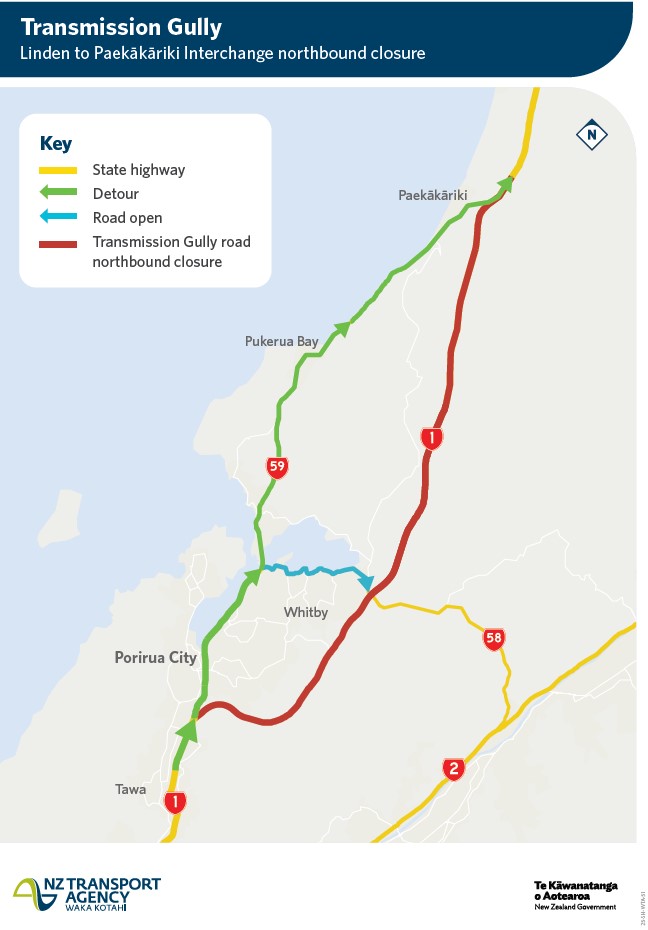
On Saturday 31 January and Sunday 1 February, Transmission Gully will have a full northbound closure from Linden to Paekākāriki, weather permitting for chipseal work. Set up for the work will get underway with a single northbound lane closure from 1pm on Saturday 31 January, with the full northbound closure (all lanes) in place from 9pm Saturday 31 January until 7am Sunday 1 February.
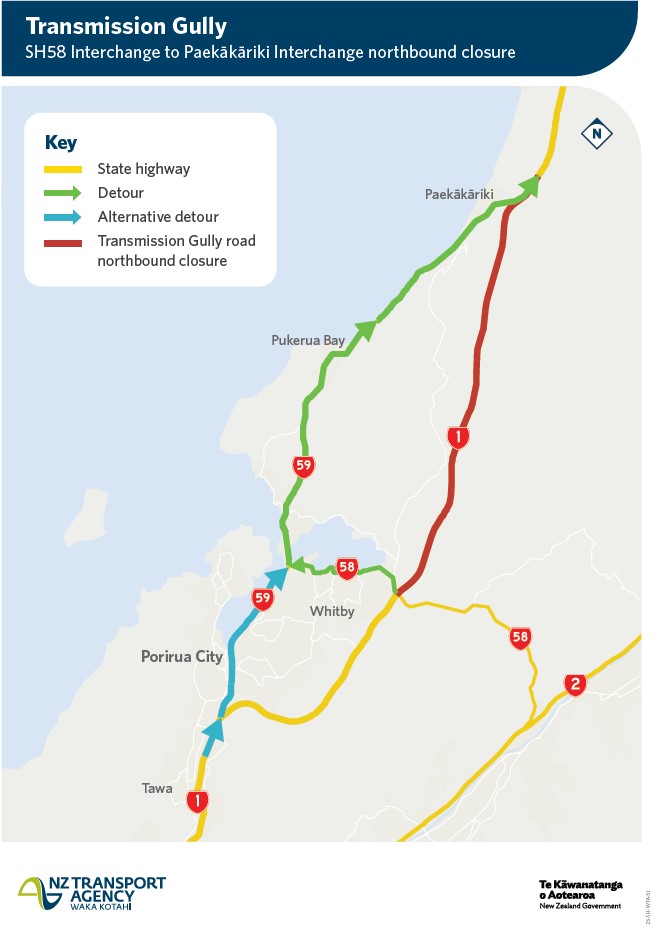
Northbound closures will also be in place from the State Highway 58 Interchange to Paekākāriki from Monday 2 February through to Thursday 5 February. Set up for the work will get underway with a single northbound lane closure from 1pm each day, with full the northbound closure (all lanes) in place from 9pm through to 7am.
There will also be a single northbound lane closure north of Battle Hill from 7pm on Monday 2 February to 5:30am on Tuesday 3 February.
With lane closures and temporary speed limits in place along the route during the day, drivers can expect delays, particularly during peak traffic and commuting periods. State Highway 59 is available as an alternative route and road users are encouraged to use it where possible.
Because the motorway is a key transport route, drivers are urged to stay up to date on the works and plan their journeys accordingly.
The road rebuild works at Waitangirua are on track and once the southbound work is completed, crews will move to the northbound lanes.
Resurfacing and chipseal works are weather-dependent and schedules may change if wet weather occurs.
It is critical for drivers to follow all temporary speed limits in areas where new chipseal has been laid. Travelling at the 30 km/h speed limit is essential. Drive too fast and you may flick up stone chips that can damage other vehicles. Drive too slowly and there is a risk the road surface will lift and stick to your vehicle.
Works schedule and detour maps
Northbound works
- Saturday 31 January and Sunday 1 February
- SH1 Transmission Gully CLOSED between Linden to Paekākāriki
- Single lane closure will be from 1pm-9pm
- Full northbound closure (all lanes) from 9pm-7am
- Northbound traffic detour via SH59
- Monday, 2 February to Wednesday 4 February
- SH1 Transmission Gully CLOSED from SH58 Interchange to Paekākariki
- Single lane closure will be from 1pm-9pm
- Full northbound closure (all lanes) from 9pm-7am
- Northbound traffic detour via SH59
Advice for drivers
Driving on new chipseal
When new chipseal is laid the loose chips are swept up and the site is road marked, normally within 48 hours of sealing, at which point the temporary speed limit is increased from 30 km/h to 50km/h.
Further sealing chip compaction occurs by managing the traffic over the site, and after a few days the site is swept again and the temporary speed limit removed.
It is critical for drivers to follow all temporary speed limits in areas where new chipseal has been laid. Travelling at the 30 km/h speed limit is essential. Drive too fast and you may flick up stone chips that can damage other vehicles. Drive too slowly and there is a risk the road surface will lift and stick to your vehicle.
When driving on newly laid surfaces sure your following distance is at least two car lengths. Avoid hard braking or sharp turns - gentle driving helps embed the chips.
Always drive to the conditions. When there is loose chip in areas outside of temporary speed limit zones, reduce your speed. This helps keep you safe and also reduces the risk of loose chips damaging other vehicles.
Wet weather and chipsealing
For chipseal to be laid effectively, it has to be done while the weather is fine. Warm temperatures and dry air help the new seal stick to the road surface and help ensure the new seal becomes strong and long lasting. Wet road conditions during sealing will affect the bond between the bitumen and the road, leading to chip seal failures.
When wet weather occurs, contractors will have to postpone road resurfacing works. This is why it is critical drivers check road conditions before they travel. Schedules are weather-dependent and can change at short notice.